
Lucky Vegas Verification UK: KYC Documents and Account Checks
 Available in GB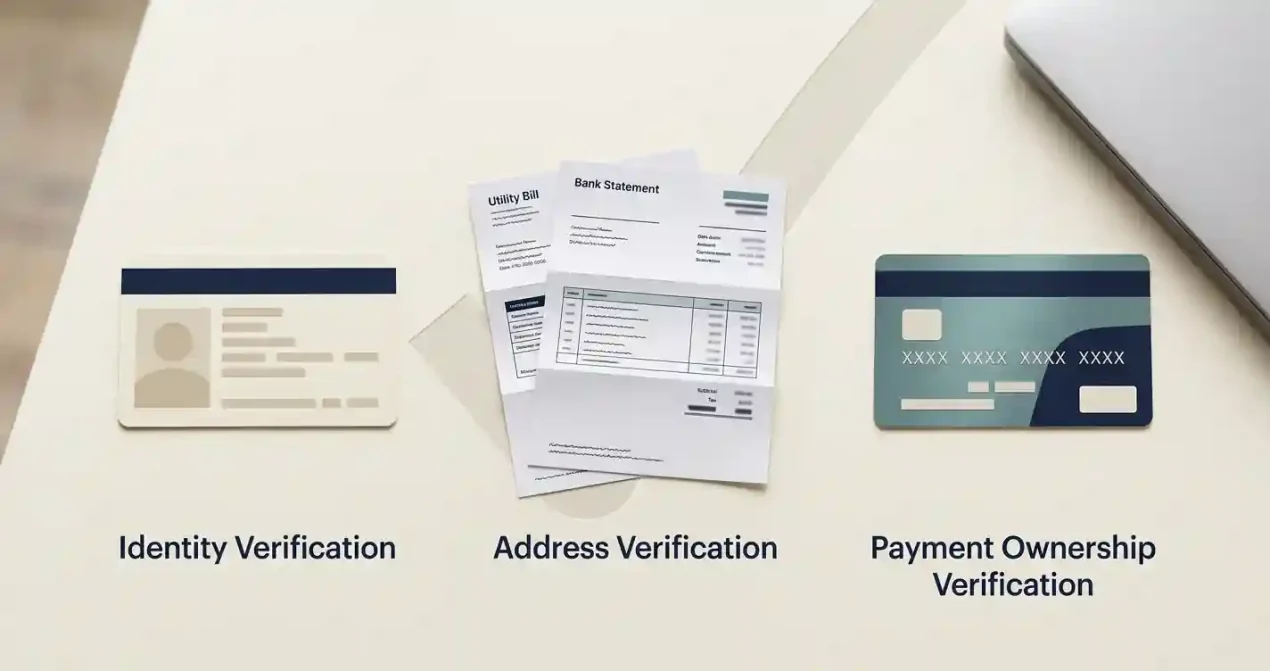
Contents
Great Britain KYC guide
Lucky Vegas requires identity and related account verification. Its current verification guidance lists three practical evidence groups: proof of identity, proof of address and, when relevant, proof connected to a payment method. For identity, the published examples include a passport, driving licence or government-issued ID. Address evidence can include a utility bill or bank statement, and a bank-card copy can be requested when a card has been used. Lucky Vegas currently says document checks are usually completed in less than 12 hours, although extra verification can take longer. In Great Britain, this process sits inside a wider rule that operators must verify core identity information before a customer is permitted to gamble.
The three parts of Lucky Vegas verification
The useful distinction is not simply “verified” versus “not verified”. The current Lucky Vegas guidance separates the evidence by what it is meant to prove. A document that proves identity does not automatically prove address, and a document that proves a customer’s address does not necessarily prove ownership of a payment method.
| Check | Current Lucky Vegas examples | What it is trying to establish |
|---|---|---|
| Identity | Passport, driving licence or government-issued ID | Who the account holder is |
| Address | Utility bill or bank statement | Whether the registered address can be supported |
| Payment method | Bank-card copy when applicable | Connection between the customer and a card used on the account |
These are accepted examples, not a promise that every customer will be asked for every item. The purpose of the check can depend on what the account already verifies automatically, which payment method has been used and whether further information is required for legal or risk reasons.
Proof of identity is about the account holder, not the payment alone
The current Lucky Vegas document guidance names a passport, driving licence and government-issued ID as identity-document examples. The key point is that this evidence is used to establish the person behind the account. A payment card in the same name is not a substitute for the operator’s identity checks.
Great Britain rules add an important baseline. Gambling Commission Licence Condition 17.1.1 requires remote licensees to obtain and verify enough information to establish a customer’s identity before allowing that person to gamble. The minimum information includes name, address and date of birth.
The detailed KYC stage should not be treated as something that exists only after a withdrawal request. Lucky Vegas registration explains how identity verification fits into account opening, while documentary checks can later require evidence for identity, address or payment ownership.
Proof of address is a separate check
Lucky Vegas currently lists a utility bill or bank statement as examples of proof of address. This category is designed to support the registered address rather than merely repeat the customer’s name. In practical terms, the useful document is one that clearly connects the account holder to the address held on the casino account.
Do not assume that an identity document will always satisfy this second purpose. A driving licence may contain an address, but the operator can still request separate address evidence depending on the verification route. The same principle works in reverse: a bank statement can support an address without being a substitute for photographic identity evidence.
Payment-method verification checks ownership, not withdrawal speed
The current Lucky Vegas guidance also covers bank-card verification where a card has been used. The important point for a UK player is the purpose of the check: it can be used to establish that the payment method belongs to the person operating the account.
That is different from a payout timetable. A card or payment-method check may be part of account verification, but it does not tell you how quickly a later withdrawal will be approved or reach the receiving account. Lucky Vegas withdrawals explains the separate payment stage so a KYC review time is not mistaken for payout speed.
Payment ownership can also become relevant when an account uses a new funding route. The verification process should therefore be read as account-specific rather than as a one-time checklist that can never change after the first successful review.
What the current Lucky Vegas verification timing means
Lucky Vegas currently says it checks documents as quickly as possible and that the process is usually completed in less than 12 hours. The same guidance notes that extra verification can take longer and advises contacting customer support if there has been no response within 48 hours.
The word “usually” matters. It describes the operator’s current document-review expectation, not a guaranteed completion deadline for every customer. A case that needs additional checks can take longer, and that does not automatically mean a withdrawal itself has been delayed for the same length of time.
This timing is also freshness-sensitive. If you are preparing documents today, the most useful final check is the current Lucky Vegas upload-documents guidance shown in your account or on the live site. Exact document examples and processing statements can be updated, while the Great Britain regulatory requirement to establish customer identity remains a separate rule.
Great Britain rules limit avoidable last-minute KYC at withdrawal
Licence Condition 17.1.1 says that a withdrawal request must not result in a requirement for additional information as a condition of withdrawal where the operator could reasonably have requested that information earlier. The rule does not stop an operator from seeking information it must obtain at that later point because another legal obligation has arisen.
That distinction is useful. It means “verification at withdrawal is forbidden” would be too broad, but it is equally wrong to treat cashout as the normal moment to begin every foreseeable identity check. Great Britain rules are designed so core identity verification happens before gambling and so avoidable requests are not stored up for the moment a customer asks for money back.
For a player, the practical response is straightforward: complete legitimate verification requests when they arrive, keep profile details accurate and do not postpone an account check simply because you have not yet requested a withdrawal.
Why Lucky Vegas can still ask for more information later
Passing an initial identity check does not turn an account into a permanently closed verification file. Operators can have continuing anti-money-laundering, fraud-prevention and safer-gambling obligations, and additional information can become relevant because of later account activity or a legal requirement that did not exist at signup.
Source-of-funds checks are account-specific, so there is no universal threshold or fixed set of financial documents that can be applied to every customer. Identity and related verification checks are part of the account process, while any additional financial evidence depends on the circumstances that trigger the check.
For the wider regulatory and operator picture behind those controls, see the Lucky Vegas safety page. It separates current licence status, safer-gambling duties and historical enforcement from the specific KYC document process covered here.
For the broader product picture, see the Lucky Vegas UK review.
How to prepare documents without creating avoidable problems
- Follow the submission instructions shown to you. Send only the evidence requested for the current check and use the account process presented at the time.
- Check legibility. Make sure the requested details are readable and that the document has not been cropped in a way that removes information needed for the check.
- Match the account details. A different name or address can create an issue that needs explanation before the evidence can support the profile.
- Protect card data as instructed. If a card copy is requested, follow the current on-screen instructions and avoid sharing information that the check does not ask for.
- Separate verification timing from cashout timing. The current under-12-hour statement relates to document checking, not a guaranteed withdrawal arrival time.
This is a better approach than uploading every personal document you possess. Verification should be targeted to the evidence the account is actually asking for.
How Lucky Vegas verification affects deposits and withdrawals
Lucky Vegas verification is best understood as an account-control process with distinct identity, address and payment-ownership checks. The current guide gives concrete document examples and says reviews are usually completed in less than 12 hours, while recognising that extra verification can take longer. In Great Britain, core identity information must be verified before gambling, so KYC is not simply a withdrawal hurdle. Later checks can still be legitimate when a new legal or account-specific reason arises, but a withdrawal should not be used to demand information that could reasonably have been requested earlier. Keeping your account data accurate and responding through the approved upload route is the most practical way to reduce avoidable friction.
This material was created by the Lucky Vegas UK Guide team.
Related posts
Lucky Vegas UKGC Licence: Skill On Net Limited and Great Britain Scope

Lucky Vegas Withdrawals UK: Process, Verification and Payout Methods