
Fruit Machine Slots UK: Online Reels and Play
 Available in GB
Contents
A practical guide to the link between pub machines and digital reels, plus game versions, practice play, limits and wagering terms.
From Pub Fruit Machines to Online Reels
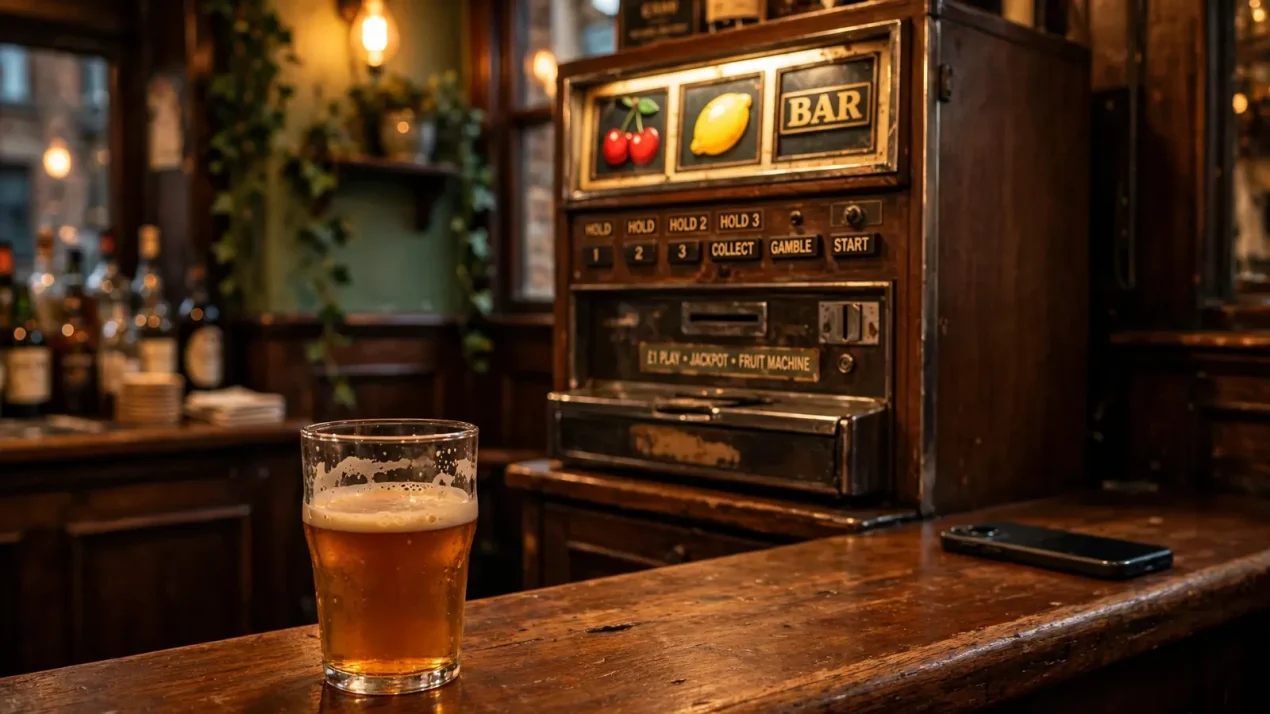
Online fruit-machine-style games take their starting point from physical fruit machines: familiar reels and symbols have been carried into software, where the presentation and underlying mechanics are digital. That connection explains the name, but it does not mean an online game behaves like a physical cabinet in every respect. A screen can reproduce the look of reels while the result is generated by a random number generator (RNG).
The distinction matters because the visible symbols are not a record of a mechanical reel stopping. The RNG produces outcomes independently, and the reels on screen present those outcomes. A run of symbols does not make a particular result due on the next spin. Nor does a machine’s physical ancestry imply that online play follows the same process as a pub cabinet. The design language may be inherited; the method of producing a result is digital.
Rainbow Riches offers a recognisable example of that transition. Barcrest introduced it on cabinets in UK pubs, arcades and betting shops in 2006, before it moved online around 2009. The name and fruit-machine styling connect the versions, but their published returns are not interchangeable: the physical machines are generally configured to pay out less than the online version’s 95% RTP. The comparison is a useful reminder that a familiar title can have different forms across settings.
When choosing fruit machine slots in the UK in 2026, payout timing is one practical detail to check. This list gives a brief reference point for each operator based on the information available.
1. WinBeast
Payout speed: 1-3 business days
WinBeast has a listed payout speed of 1–3 business days.
2. Zombillion
Payout speed: 1-3 business days
Zombillion has a listed payout speed of 1–3 business days.
3. Chanze
Payout speed: 1-3 business days
Chanze has a listed payout speed of 1–3 business days.
4. BeOnBet
Payout speed: 1-3 business days
BeOnBet has a listed payout speed of 1–3 business days.
5. Jetsetspins
Payout speed: 1-3 business days
Jetsetspins has a listed payout speed of 1–3 business days.
6. Revery Play
Payout speed: 1-3 business days
Revery Play has a listed payout speed of 1–3 business days.
7. Dieselwin
Payout speed: 1-3 business days
Dieselwin has a listed payout speed of 1–3 business days.
8. SpinFormula
Payout speed: 1-3 business days
SpinFormula has a listed payout speed of 1–3 business days.
9. NightWin
Payout speed: 1-3 business days
NightWin has a listed payout speed of 1–3 business days.
10. NightLuck
Payout speed: 1-3 business days
NightLuck has a listed payout speed of 1–3 business days.
The older, pared-back format is often described as a classic fruit slot. Its usual visual structure is a three-reel layout with a single payline, and the feature set is minimal. The simplicity is structural: fewer reels and one line make it easy to see which symbols need to align for a line win. This is closer to the compact fruit-machine format many players recognise than a larger game built around numerous routes across the screen.
Modern fruit machines commonly use a five-reel, three-row grid. A fixed-payline game sets the permitted lines in advance; the relevant symbols must land on one of those routes for a line win. Such games can have between 10 and 50 fixed paylines. The number of lines changes how many symbol paths are evaluated, not the independence of the underlying random outcomes.
A different arrangement is labelled “243 ways to win”. It is not a claim that the game has 243 conventional paylines. Instead, wins are assessed through combinations across adjacent reels, with the symbol positions creating multiple possible routes. That changes how the grid is read: attention moves from tracing a set line to identifying matching symbols across the reels. The number describes the ways-to-win structure, not a forecast of how often a winning combination will appear.
The word “reel” also covers formats that depart further from the classic cabinet. Megaways games use a dynamic reel system in which the number of symbols on each reel changes from spin to spin; the arrangement can produce as many as 117,649 ways to win. That is a substantial expansion from one fixed line, but it remains a description of possible winning routes, not a measure of likely returns. A larger route count is not, by itself, evidence that a game is more favourable.
These formats therefore sit on a spectrum. At one end is the three-reel, single-payline classic, with a spare layout and few added features. In the middle are five-reel grids with fixed lines or a ways-to-win structure. At the more variable end are formats such as Megaways, where reel heights change. They share fruit-machine ancestry, but the screen layout determines how combinations are presented and assessed.
Progressive Slots Online in the UK: How Jackpots Work
That vocabulary is useful when looking at a game’s rules. “Three reels” describes the columns; “three rows” describes the visible positions in a common modern grid; “fixed paylines” means the lines are predetermined; and “243 ways to win” describes a different method of counting combinations. These labels identify structure, not quality. A familiar fruit motif may sit on a traditional layout or a more elaborate digital grid, so the title or artwork alone does not establish which format is being played.
How Holds, Nudges and Random Outcomes Fit Together
Holds and nudges are features that change what happens on screen during a fruit-machine round. They can introduce a choice or an extra movement between spins, but they do not give a player control over the random process that determines the result. That distinction matters: an action may affect the displayed reel positions without making a particular outcome more likely.
UK Video Slots: How Reels, Bets and Wins Work
A hold keeps a selected reel in place while the other reels spin again. Rather than having every reel move, the game carries the held symbol or symbols into the next round and re-spins the rest. The purpose is to see whether the resulting arrangement forms a winning line. The hold changes which reels move; it does not change the underlying random outcome process.
A nudge works differently. It moves a reel by one position, shifting a different symbol into the payline in an attempt to create a win. Depending on the game, the movement may be offered after a spin as part of its feature. A nudge is therefore a change to the reel’s displayed position, not a way to select a particular symbol or guarantee that the line will pay.
The two features can feel like small decisions with visible consequences. A hold preserves part of the current arrangement while the other reels re-spin; a nudge changes a reel’s position after the spin. In both cases, the player sees an opportunity to affect the arrangement. That is not the same as influencing the random process behind the result. Holds and nudges add variety and decision points, not a method for directing outcomes.
Bonus-buy slots in the UK: demo play and terms
Conditions depend on the individual game
There is no single set of hold or nudge rules that applies to every online fruit machine. Their number and availability vary by title, and a feature may be offered only when specific conditions are met. One game might present a hold or nudge in a particular situation, while another may handle the feature differently. Some titles may offer more than one hold or nudge, but that should not be assumed without checking the rules for that game.
A specialist review has described hold and nudge availability as dependent on a title’s conditions. That is a report about how particular games can work, not a rule that can be applied to every title. The game’s own instructions are the relevant place to establish what its feature permits: when it can appear, which reels can be held or moved, and whether the option is available at all in a given round.
The distinction between a feature being present and being available is useful. A title may include a hold function, yet the feature may not appear on every spin. Likewise, seeing a nudge in one situation does not establish that it can be used whenever a reel looks close to a winning line. The conditions belong to the specific game, rather than to fruit slots as a category.
What a choice does—and does not—change
When a hold is selected, the game keeps the chosen reel in place and re-spins the others. When a nudge is used, a reel shifts by one position. These actions change the visible sequence of play. They do not let the player set the result, and they do not turn a near miss into a guaranteed win.
Do
- Treat holds and nudges as game actions
- Read feature descriptions as operating instructions
- Acknowledge the random process behind outcomes
Don’t
- Use features to predict the next result
- Assume a nudge guarantees a winning line
- Treat a near miss as a sign of a due win
The same point applies to the way a feature is presented. A prompt to hold or nudge can make a round feel more interactive than a straightforward spin, because there is a decision to make and the reels respond on screen. The interaction is part of the game’s design. It does not establish that one choice improves the chance of a payout or that a particular arrangement is due to become a winning line.
For UK online fruit slots, the practical way to interpret a hold or nudge is therefore narrow: it describes a game action, not a prediction. The feature may preserve or shift reel positions, according to that title’s rules; the outcome remains governed by the random process. A previous hold, a previous nudge, or a run of unproductive spins does not provide a basis for predicting what the next outcome will be.
This avoids confusing two different things: control over an on-screen action and control over chance. A player may be able to choose whether to keep a reel in place or use an offered nudge, if the game allows it. That choice can alter the displayed arrangement. It cannot remove randomness from the outcome or establish that a win will follow.
In a fruit slots online casino, the feature description should be read as a set of operating instructions for that title. The number of holds or nudges, the circumstances in which they appear, and the effect on reel movement are game-specific. Treating them as a universal system would overstate what the feature does. Treating them as a way to beat random outcomes would overstate it further.
Progressive jackpot slots: how shared pools work
Fruit Slots at UK Online Casinos: Licence and Game Versions
A fruit machine title appearing in a casino lobby is only one part of the check. The operator’s legal status and the version of the game actually available both matter. A familiar name or matching artwork does not, by itself, establish either point.
For online casino games offered to customers in Great Britain, the relevant operator must hold a current licence from the UK Gambling Commission. The requirement applies to operators serving the British market regardless of where the business is based. A company operating from abroad is not exempt simply because its offices or servers are elsewhere. A supplier’s credentials are not a substitute for the casino operator’s licence either.
That distinction is practical, not cosmetic. The licence identifies the regulatory framework under which the casino is permitted to offer gambling to UK customers. Offshore casinos without a UK Gambling Commission licence sit outside that framework. Their availability on a website does not make them UK-licensed, and a large fruit-game catalogue does not change the position. UK players using an unlicensed offshore site lose access to UK protections, including the relevant complaints and self-exclusion routes. Unlicensed sites may also manipulate games or withhold payouts, leaving players with limited or no legal recourse.
Unlicensed Casinos
UK players using unlicensed offshore sites lose access to UK protections and face risks of manipulated games or withheld payouts.
The operator and the game are separate checks. A licensed casino can host games supplied by different studios, while the same title may be distributed in more than one version. The presence of a provider’s name, or a game’s familiar title, does not prove that every build or return setting is live at every casino. The game information displayed inside the casino is the more useful record for the version being offered there.
RTP, or return to player, is a theoretical figure describing the proportion of stakes a game is designed to return over a very large number of plays. It is not a promise about an individual session, nor does it state what a particular player will receive. More importantly for checking a fruit machine game, a published RTP may differ between versions of the same title. A figure quoted in a general review can therefore fail to describe the build opened at a particular casino.
A specialist review has noted that game versions can carry different published RTPs. The practical check is the game’s own paytable or help screen after it has been opened at the casino being considered. That screen is tied to the version presented there; a provider’s general game page or a third-party description may refer to another configuration. If the RTP is not displayed clearly, the figure should not be assumed from a similarly named version elsewhere.
Online Slot Payout Percentages and RTP Explained
The check should also match the exact title. A sequel, a themed variant and a game with a near-identical name are distinct products, even if the graphics or symbols make them look related. A catalogue entry is not enough to identify the return setting, since the relevant details belong to the playable version. The name, version information and paytable should be read together.
This matters for classic fruit machine games as well as newer fruit-themed releases. A simple layout can still have a defined paytable and a published return, while a more elaborate game can have settings that are not identical across casinos. Visual familiarity is not a measure of the version’s terms. The reels may look unchanged while the displayed RTP differs.
A sensible order of checks is therefore straightforward: confirm that the casino operator holds a current UK Gambling Commission licence, open the actual game, then inspect its in-game information. The licence addresses whether the operator is authorised to serve the market; the paytable addresses the version’s published game details. Neither check replaces the other.
Casino listings and promotional pages can make fruit machine titles easy to spot, but they are not the final record for either issue. The operator’s licence status should be established independently, and the game’s own help or paytable should be consulted before play. This avoids treating a third-party RTP as if it belonged to the casino’s version, or treating an overseas operator’s access to a UK visitor as evidence of UK authorisation.
Verification Order
Step 1: Check Licence
Confirm that the casino operator holds a current UK Gambling Commission licence.
Step 2: Open Game
Launch the specific fruit machine title you intend to play.
Step 3: Inspect Information
Consult the in-game paytable or help screen to verify the version’s published RTP.
A fruit slot casino is not defined by its collection alone. For a UK-facing service, the operator must have the required local licence; for a specific fruit machine, the applicable published RTP is the one attached to the version available in that casino. The distinction keeps the legal question separate from the game-data question, where a familiar title can otherwise do too much persuasive work.
Comparing Fruit Slots by RTP, Reels and Features
A useful comparison starts with the game’s published return to player (RTP), then checks how its reels and winning structure work. These measures describe different things: RTP is a theoretical return across play, while the reel layout and win system determine how symbols can combine on an individual spin. Neither measure identifies a universally best fruit slot. The practical choice depends on which format and rules suit the intended session.
Read RTP as a comparison measure
UK fruit-machine-style slots commonly sit within a 94% to 97% RTP range, although some titles fall outside it. RTP is expressed as a percentage, so it can help compare games when the figures are stated on the same basis. It is not a forecast of what a particular session will return. A game at the upper end of the typical range does not guarantee a better result on a given spin, and a short run cannot be judged against the theoretical figure as if it were a repayment schedule.
That distinction matters when looking for the best fruit slots in the UK. A higher published RTP is one measurable point, not a complete verdict. It says nothing on its own about whether the game uses a compact classic layout, a multi-line grid or a changing reel system. Nor does it establish that the game will feel more suitable or produce more frequent wins. Those are separate considerations, and comparisons become misleading when they are collapsed into a single ranking.
Compare the reel structure
Many modern fruit machines use a grid with five reels and three rows. Fixed-payline games have a set number of lines across which matching symbols can form wins; the cited range for these games runs from 10 to 50 paylines. The exact arrangement matters because a title with more lines is not automatically better value. It changes how the game defines winning combinations, but does not by itself establish the size or frequency of returns.
Fixed Paylines
Symbols must land on predetermined routes. Typically ranges from 10 to 50 lines.
243 Ways to Win
Wins are assessed through combinations across adjacent reels without fixed drawn lines.
Megaways
Dynamic reel system where symbol counts change per spin, producing up to 117,649 ways to win.
Some games instead use 243 ways to win. This is not another name for 243 paylines. It describes a system in which matching symbols can form combinations across the reels without relying on a fixed set of drawn lines. A comparison should therefore record the win system as well as the reel count. Two games can both display five reels and three rows yet evaluate combinations differently.
Megaways uses a different structure again: the number of symbols shown on each reel changes from spin to spin. The system can generate as many as 117,649 ways to win. That figure describes the possible ways created by the dynamic reel arrangement, not a promise that a spin will win or that the game has a higher RTP. Treating ways-to-win totals as a quality score confuses a structural feature with a return measure.
Build a like-for-like comparison
A compact comparison table can keep the relevant measures separate:
| Measure | What to record |
|---|---|
| RTP | The published percentage |
| Reel layout | Reel count and visible rows |
| Win structure | Fixed paylines, 243 ways to win, or a dynamic system |
| Features | The features stated in the game rules |
This is a framework, not a ranking. The table prevents one striking figure from dominating the assessment. For instance, a large number of ways to win does not replace the RTP figure, while a higher RTP does not tell whether the game uses fixed lines or a dynamic reel structure. Each entry answers a different question.
Features should also be compared by their stated rules rather than by their names or promotional descriptions. Record what the game offers, then consider whether that changes the format being assessed. A feature count is not a substitute for the core measures: it does not show the RTP, the number of fixed paylines or how combinations are evaluated. Where the available description does not provide a comparable measure, the comparison should leave that field blank rather than infer a value.
For anyone comparing pub-style fruit slots, the same method applies. “Classic” or “pub style” may describe the presentation, but the measurable points remain the game’s stated RTP, reel layout and win system. A shortlist labelled the best fruit machine slots in the UK is only useful if those details are visible and comparable. A title’s name or theme cannot fill gaps in the figures.
Bonus offers are a separate calculation from game comparison. They do not change a title’s reel structure or make its RTP a prediction of session results. Keeping the game measures apart from promotional terms produces a cleaner decision: compare the mechanics and published return first, then assess any offer on its own conditions.
Online Casino Tournaments UK: Free Slot Entry Rules
Real-Money Play: Age Checks, Stake Caps and Limits
Real-money fruit slots in the UK require both an eligible age and a verified identity. Registration is not simply a way to create a username: the operator must establish who is opening the account and confirm that the person is at least 18. Until those checks are complete, real-money play is not available. A game’s appearance or accessibility on a screen does not change that requirement.
The per-spin stake cap depends on age. In Great Britain, players aged 25 and over may stake no more than £5 on a spin; for those aged 18 to 24, the limit is £2. These are maximums, not recommended stakes or targets. A lower stake remains a lower financial exposure per spin, while the cap does not set a safe overall spend for a session.
The limit applies at account level, not merely as a setting that can be ignored in an individual game. Operators must prevent a stake above the applicable cap, regardless of the title selected or the amount available in the account. That distinction matters: a player should not have to rely on remembering a maximum while changing games or adjusting the stake. The operator’s controls must block an over-limit spin.
Stake Caps
In Great Britain, the maximum stake per spin is £5 for players aged 25+ and £2 for those aged 18 to 24.
A capped stake is not a capped loss. Repeated spins can still use up a budget, and the maximum permitted amount does not indicate how long funds will last or what a session will return. Fruit machine slots for real money therefore need two separate figures in any personal budget: the stake per spin and the total amount that can be lost. The second figure is the meaningful boundary for spending; it should be set before play and should not be expanded to recover earlier losses.
Many UK-licensed operators provide account tools such as deposit limits, session time reminders and reality checks. These can make spending and time more visible, but their presence does not replace a budget. A deposit limit constrains what can be added under the selected setting; it does not guarantee that the amount deposited will last for a particular period. A reminder or reality check supplies information about a session, not a prediction of its outcome.
For real-money fruit machine slots, the practical order is straightforward: complete identity and age verification, keep each stake within the applicable cap, and decide the total affordable loss before starting. If the session reaches that boundary, stopping preserves the budget. Increasing it after losses changes the amount at risk, not the chance of recovering what has already been spent. Treating winnings as income would also turn a variable result into a plan; they are better treated as incidental.
Account limits and reminders are controls around play, not a source of expected value. The arithmetic remains plain: a legal maximum stake is only the largest permitted single bet, while the session budget is the player’s own limit on total expenditure. Keeping those measures separate is more useful than treating a compliant stake as evidence that the overall spend is affordable.
Free Fruit Slots: What a Practice Session Can Show
A free session can show how an online fruit machine presents its game: the symbols, menu layout, pace of play and the way its controls respond. It gives a low-stakes setting for getting familiar with the screen before deciding whether the format is enjoyable. That is the practical value of free play; it is not a preview of what a paid session will produce.
Online fruit-machine-style games descend from physical fruit machines, but their outcomes are generated digitally. A random number generator (RNG) produces independent outcomes, so a run of wins or losses in practice does not establish what will happen next. Nor does a large practice win indicate that a similar result is likely when money is involved. Each spin remains a separate outcome, not a continuation of the session’s apparent trend.
The distinction matters because practice play can feel persuasive. A session may contain a winning sequence, or it may produce very little. Neither result changes the underlying random process or provides a reliable forecast. A free balance is not a financial test: it does not show how long a real-money balance would last, what a player might win overall or whether paid play would be worthwhile.
Attention: Results achieved during a free practice session do not forecast real-money outcomes due to the independent nature of the RNG.
Free play should also be kept separate from a promotional offer. Access to a practice mode is not, by itself, a deposit bonus or a set of free spins with promotional conditions. Where an offer is involved, its eligibility and terms determine what it applies to; the presence of a free-play option does not establish that the game qualifies. The two may appear near each other, but they are different arrangements.
A useful practice session has a narrow purpose: checking whether the game’s presentation is clear and whether its pace suits the intended entertainment. It can reveal whether the interface is comfortable to use and whether the format holds interest. It cannot establish the likelihood of future wins or turn random results into a strategy.
For that reason, free fruit slots are best understood as a way to explore a game without staking money, not as a route to expected returns. A practice result belongs to that session alone. Treating it as evidence about a later paid session assigns it a value the independent outcomes do not support.
Free and Fruit-Themed Games, Without Assuming Every Title Qualifies
Fruit-themed games range from recognisable pub-fruity names to newer titles that use familiar imagery in a different format. The title alone does not establish how a game plays, whether it is available for free, or whether it counts towards a casino promotion. Those are separate questions, and each depends on the game and the terms in force.
Rainbow Riches is a notable example of a fruit-machine name that moved between physical and online play. Barcrest introduced it on cabinets in UK pubs, arcades and betting shops in 2006; it reached online play around 2009. That history explains its association with the traditional fruit-machine market, but it does not mean every online version has the same presentation or terms.
Other names in this area include Rainbow Riches Pick’n’Mix, Rainbow Riches Megaways, Rainbow Riches Freespins, Piles of Cash and Rainbow Reveal. These are examples of titles, not evidence that they are currently offered by a particular casino, available in a free mode, or included in an incentive. Availability can differ between operators, and a title’s name is not a substitute for checking its game information.
“Free” can describe different things
A game may be playable without a cash stake, while a promotion may award spins or bonus funds subject to separate conditions. Those are not interchangeable. A free-play option does not establish that a real-money promotion applies, and a promotional offer does not mean every fruit-themed title is eligible.
The relevant detail is the live promotion wording: it identifies qualifying games and any contribution rules used to calculate progress. A large catalogue, or a category labelled “fruit”, does not make all its titles count. If the named game is absent from the eligible-games information, its theme is not a reason to assume otherwise.
Promotional Eligibility
A fruit-themed title does not automatically qualify for a promotion. One must check the live promotion wording to identify qualifying games and contribution rules.
The same applies when a promotion refers broadly to slots or casino games. The wording may narrow eligibility to selected titles, or assign different contribution treatment to different games. The effective value of an offer therefore depends not just on its headline amount, but on which games can be used and how their play is counted. If those conditions are unclear, the offer’s practical value cannot be calculated from the headline alone.
Check the title, then the terms
A sensible comparison separates three points: whether the game is present at the chosen casino, whether it can be played without a cash stake, and whether it qualifies for the relevant promotion. Confirmation of one point does not confirm the others. A title visible in a lobby may be available only for real-money play; a free-play version may not be part of a promotional offer; and a promotional game may be subject to its own contribution rate.
Promotional terms should be checked at the time of opting in, rather than inferred from an old review, a game’s branding or a general category page. Offers and game lists can change. The current terms are the operative record of eligibility, not the fact that a game looks like a classic fruit machine.
This distinction matters particularly for familiar names. Rainbow Riches may evoke a physical pub machine, while a related online title can have a different format and separate promotional status. The name provides context; the operator’s live game and offer information determines availability and eligibility.
Classic Fruit Slots and the Cost of Bonus Wagering
Fruit Slot Demos: Check the Version Before Playing
A fruit slot demo can show how a particular game is presented: its symbols, screen layout, paytable and available controls. It is useful for identifying the version on screen, rather than assuming that every game with the same title has identical settings. A demo is an inspection tool, not a forecast of real-money results.
Penny Slot Machines in the UK: Stakes and RTP
Before treating the display as representative, compare the game title and provider details with the version offered for real-money play. Then open the game information or paytable in that casino. Published RTP can differ between versions of the same title, so a figure quoted in a specialist review is not enough to establish the RTP of the build currently available. The casino’s own paytable is the relevant place to check.
The distinction matters even when the artwork and name appear unchanged. A game may look familiar while its published return differs by version. Recording the displayed RTP alongside the title and casino makes comparisons less prone to mixing one build’s figures with another’s.
A demo can also reveal practical details that a title listing cannot: how winning combinations are displayed, where the paytable sits and how the game’s controls work. Those observations describe presentation and mechanics only. Online fruit-machine-style games use random number generators, with independent outcomes; a sequence seen in a demo does not indicate what a later spin will produce.
No demo result establishes a likely return, a future win or a pattern that can be carried into paid play. The useful check is narrower: confirm that the game being inspected is the intended title and version, then verify its published RTP in that casino’s paytable before playing for money.
Free Spins and Bonus Terms: The Amount That Must Be Wagered
Free spins may appear as an in-game feature or as part of an offer. If an offer adds bonus funds, its terms should state the wagering requirement and which games count towards it. A large game library does not mean every fruit machine contributes.
The UK Gambling Commission’s Social Responsibility Code 5.1.1 caps wagering on bonus funds at ten times the bonus amount. A £50 bonus therefore requires £500 in qualifying bets before bonus-derived funds can be withdrawn. The total is turnover, not a required loss; the result of those spins remains uncertain.
Can I play fruit slots for real money in the UK?
Yes. You must be at least 18, complete identity verification and play with an operator holding a valid UK Gambling Commission licence.
Are online fruit machine slots rigged?
Online fruit slots use random number generators to produce independent outcomes. A run of symbols does not make a particular result due on the next spin.
What is the best fruit machine slot for beginners in the UK?
A classic three-reel slot with a single payline is a straightforward choice: its layout is simple and has few extra features. Check the specific game’s rules and paytable before playing.
Can I play fruit machine slots on my mobile phone?
Yes. Online fruit machine games may be compatible with mobile phones.
How can players win at fruit machine games?
Players win when the symbols form a combination that pays under the game’s rules. Holds and nudges can change the displayed reel arrangement, but they do not control the random outcomes or guarantee a win.
This material was created by the Lucky Vegas UK Guide team.
Related posts

UK Online Casino Ratings and Amatic Games

Wazdan Online Casinos in the UK: Availability Checks
