
European Roulette in UK Online Casinos: Odds and Bets
 Available in GB
Contents
The single-zero wheel gives each of its 37 pockets an equal chance, shaping bet probabilities, payouts and the house edge.
How European Roulette Sets Its Odds
European roulette’s baseline is set by the wheel, not by the colour or position of a wager. It has 37 pockets: the numbers 1 to 36 and one zero. Each pocket is a possible landing place for the ball. Because there is one zero alongside the numbered pockets, the wheel has more possible outcomes than a set containing only the numbers players commonly select.
For a single spin, each pocket has the same chance of being selected: one outcome out of 37. A particular number therefore has a probability of 1 in 37, or approximately 2.70%. The same underlying count applies to any selection of pockets: its chance depends on how many of the 37 possible outcomes it covers. The wheel does not give a number extra probability because it appeared recently, or because it has not appeared for some time.
That equal chance is the starting point for understanding the house edge. A roulette bet has a defined return if it wins, while the probability of winning is determined by the pockets that would produce that result. The return is set against those odds. Across all possible outcomes, the difference between the amount wagered and the theoretical amount returned is the house edge. On European roulette, that edge is 2.70%.
When choosing an online casino for European roulette in the UK, payout timing is one practical detail to check alongside the game itself. This list highlights the payout-speed information available for each operator.
1. WinBeast
Payout speed: 1-3 business days
WinBeast lists a payout speed of 1–3 business days, a useful detail when considering how quickly withdrawals may be processed.
2. Zombillion
Payout speed: 1-3 business days
Zombillion lists a payout speed of 1–3 business days, giving readers a stated timeframe to factor into their choice.
3. Chanze
Payout speed: 1-3 business days
Chanze lists a payout speed of 1–3 business days, providing a clear point of reference for withdrawal timing.
4. BeOnBet
Payout speed: 1-3 business days
BeOnBet lists a payout speed of 1–3 business days, which may help readers assess whether its stated timing suits them.
5. Jetsetspins
Payout speed: 1-3 business days
Jetsetspins lists a payout speed of 1–3 business days, offering a stated timeframe to consider when reviewing the operator.
6. Revery Play
Payout speed: 1-3 business days
Revery Play lists a payout speed of 1–3 business days, a practical detail for readers weighing withdrawal timing.
7. Dieselwin
Payout speed: 1-3 business days
Dieselwin lists a payout speed of 1–3 business days, giving readers an indication of its stated payout timing.
8. SpinFormula
Payout speed: 1-3 business days
SpinFormula lists a payout speed of 1–3 business days, a useful reference when considering how soon payouts may be processed.
9. NightWin
Payout speed: 1-3 business days
NightWin lists a payout speed of 1–3 business days, providing a stated timeframe for readers to keep in mind.
10. NightLuck
Payout speed: 1-3 business days
NightLuck lists a payout speed of 1–3 business days, offering a concise reference point for withdrawal timing.
The zero is the mechanical source of that margin. A set of 36 numbered outcomes would not have the same odds as a wheel that includes those numbers plus a separate zero. The zero occupies a pocket of its own and is part of the same random outcome as every numbered pocket. It is not a pause between spins, a bonus result or an event outside the calculation. It belongs in the denominator whenever the probability of a result is assessed.
This is why the house edge is a property of the game’s structure rather than a prediction about a particular session. It describes the average mathematical effect of the wheel and its rules over repeated play. It does not say that a specific spin will produce a loss, nor does it describe what must happen next. A short sequence can differ sharply from the long-run expectation because each spin ends in one pocket and chance does not distribute outcomes evenly on demand.
The distinction between probability and expectation matters. Probability measures how likely a result is on one spin. The house edge measures the game’s theoretical financial balance across all possible results, after the relevant returns are taken into account. A result may be likely without making a game favourable, and an unlikely result may still occur. The edge does not forecast the order in which numbers will appear.
French Roulette Online Casinos in the UK: Rules & Odds
For the same reason, previous spins do not alter the wheel’s physical count. Once a spin is complete, the next spin again has 37 possible pockets. A run of one colour, a cluster of nearby numbers or a long interval without a particular number does not remove pockets from the next calculation. Treating recent history as a change in the odds confuses a record of past outcomes with the mechanism producing a new one.
The 2.70% figure is also not a charge removed from every individual stake at the moment it is placed. It is a theoretical edge, expressed as a proportion of the amount wagered over time. Actual results can sit above or below that expectation, particularly over a limited number of spins. The longer-run measure is useful for comparing the mathematical structure of games; it is not a session forecast or a promise of a particular return.
In an online casino, European roulette may be presented on a screen, but the central calculation remains the same when the game follows the standard European rules: 37 possible pockets, including a single zero, and a 2.70% house edge. The interface can change how the game is displayed, but it does not change the wheel’s underlying count. Any variation to the rules would need to be assessed on its own terms rather than assumed to share this baseline.
The practical value of this baseline is precision. European roulette is not a game with 36 equally weighted outcomes; the zero is one of the 37 equally possible landing places. That additional pocket is small in visual terms and decisive in the arithmetic. The house edge follows from the relationship between the full set of outcomes and the returns attached to wagers, not from a pattern that can be read off the last spin.
On European roulette, the house edge is 2.70%, which is a property of the game’s structure and remains constant regardless of previous spins or recent results.
European Roulette Bets and Their Payouts
A roulette payout is quoted as winnings relative to the stake. A winning wager also returns the original stake, so a 35:1 return means the winnings are thirty-five times the amount placed on the number, with the stake returned separately. The quoted odds describe the payment for a win; they do not change the chance of the ball landing on a chosen outcome.
Inside bets
Inside bets cover specific numbers or small groups of numbers. A straight-up wager selects one number and pays 35:1 if that number wins. The same straight-up payout applies on European and American roulette.
A split wager covers two adjacent numbers and pays 17:1 when either one wins. It has a lower return than a straight-up bet because it covers more possible winning numbers. A street wager covers a horizontal row of three numbers and pays 11:1. These payouts follow the size of the winning group: as a bet covers more numbers, its payout falls.
For anyone learning how to play European roulette, the distinction is useful: the selected group determines which results count as a win, while the payout states the amount returned if one of those results occurs. Neither the bet name nor its payout changes the result of a spin.
Outside bets and zero
Outside bets cover broader categories. Red or black, even or odd, and high or low each pay 1:1 when successful. A winning wager therefore returns winnings equal to the stake, plus the stake itself.
Live Dream Catcher Casino UK: How It Works
These bets do not cover the zero. On a standard table, a zero result defeats an even-money wager. La Partage changes that settlement: when the ball lands on zero, half of an even-money stake is returned rather than the whole wager being lost. The rule reduces the house edge on those bets to 1.35%. It applies to even-money wagers, not as a general change to every payout on the table.
That distinction matters when comparing European roulette payouts. A displayed 1:1 return describes a win on red, black, even, odd, high or low; La Partage describes what happens to the stake if zero appears instead. It does not turn zero into a winning result for those bets.
Reading the return
A payout table is easiest to interpret when the quoted odds are kept separate from the stake and from the chance of winning. A 35:1 straight-up return is larger than a 1:1 outside return, but it is attached to a narrower outcome. The larger figure is not a measure of value on its own.
The same settlement rules apply whether European roulette is played online in the UK or at a physical table, provided the game uses the stated rules. Free play can help make the payout display familiar, but it does not change the meaning of the odds. A VIP label is not itself a different payout rule; the table’s published rules determine how winning bets and zero are settled.
Reading the Single-Zero Wheel
A European roulette wheel has pockets numbered from 1 to 36, plus one pocket marked zero. That single green pocket is the defining feature of the European layout. It is also why the wheel and the betting table need to be read as related but separate surfaces: numbers arranged beside one another on the felt do not necessarily sit beside one another on the wheel.
Attention: Numbers that appear adjacent to one another on the betting felt do not necessarily sit beside one another on the physical wheel.
The wheel’s numbered pockets follow a fixed physical sequence around its rim. A wager on neighbouring numbers refers to their positions in that sequence, not simply to numbers that appear close together on the table. The distinction matters when a game offers wagers based on wheel sectors or adjacent pockets. Those bets are defined by the wheel’s order; the felt’s rows and columns are only a convenient way to place chips.
The zero sits among the numbered pockets rather than outside the sequence. It is not part of the red or black groups, nor does it belong to either side of the even-money divisions. Its presence affects how a spin relates to the betting choices, but it does not change the meaning of the other pocket labels. Each number remains a distinct outcome, whether it is selected alone, grouped with nearby wheel numbers, or covered through a broader betting area.
Inside bets and outside bets describe different ways of selecting outcomes, not different wheels. An inside wager is attached to particular number positions on the layout; an outside wager covers a category shown in a separate betting area. Neither term says whether selected numbers are physically adjacent around the rim. A group that looks compact on the felt may not form a neighbouring run on the wheel, and a wheel-based group can cross several areas of the table.
This is why the phrase “single-zero table” can be misleading if it is taken to describe only the printed felt. The zero pocket belongs to the wheel, while the table displays a betting grid and other selection areas. The table may make number groups easy to identify, but it does not reproduce the wheel’s physical sequence. For any wager tied to neighbouring pockets, the wheel order is the relevant reference.
Monopoly Live Casino UK: Format, Play and Terms
A street bet illustrates the felt’s own grouping logic: it covers a horizontal row of three numbers, and a winning street bet pays 11:1. That group is defined by its position on the table, not by the three pockets being consecutive around the rim. The distinction is practical, not cosmetic; the name of a wager may describe its placement while a different wager type may describe a relationship between wheel pockets.
When a roulette interface shows both a wheel and a betting grid, each answers a different question. The wheel identifies the physical pocket sequence and the single zero. The grid identifies where a chip can be placed and which number or category that position represents. Keeping those references separate makes wheel-based selections easier to interpret without treating the table layout as a map of the wheel.
European Roulette Tables: Layout and Bet Placement
A European roulette casino table separates the betting layout from the wheel. The wheel has numbered pockets; the felt displays betting spaces where wagers are recorded before a spin. The familiar grid of numbered squares is therefore a betting map, not a diagram of the order in which pockets sit around the wheel.
On the felt, the numbers from 1 to 36 appear in three vertical columns, with each number occupying its own square. The single zero sits apart from that numbered grid, at one end of the layout. Colours on the numbered squares distinguish red numbers from black ones, while the zero is green. The table’s arrangement makes it possible to select an individual number or a boundary shared by neighbouring numbers without confusing either position with the physical wheel.
Do
- Place a chip within one square for a straight-up wager
- Place a chip across the shared border for a split bet
- Use labelled sections for outside bets
Don’t
- Confuse a chip on a boundary line with a single-number wager
- Assume the table layout reflects the wheel’s physical sequence
- Treat the betting grid as a diagram of the wheel
Inside bets go on or between numbered squares. A chip placed within one square marks a wager on that number. For a split bet, the chip sits across the line separating two adjacent numbers; the position matters because a chip wholly inside one square indicates a different selection. Other inside positions use intersections or shared edges to cover several numbers. The marked area, rather than the chip’s apparent proximity to a number, identifies the wager.
Outside bets occupy labelled sections beyond the numbered grid. These include red or black, odd or even, low or high, and the dozen and column areas. A chip placed in one of these boxes selects the printed group. The boxes are broader than individual number squares because each covers a category rather than a single result. Red/black, even/odd and high/low are even-money wagers, but the practical point here is location: each has a distinct betting area outside the grid.
A split illustrates why placement and payout should not be treated as the same thing. On a European table, a split on two adjacent numbers pays 17:1, but that return does not change where the chip must go: across their shared border. The table records the selection; the rules determine what a winning selection returns.
Online layouts preserve this basic logic on a screen. A click or tap selects a square, boundary or labelled outside area, and the interface displays the resulting wager on the felt. In live play, the same layout may be shown beside the streamed wheel, but the betting map remains separate from the wheel itself. A sound European roulette strategy begins with reading that map accurately: a chip on a line is not interchangeable with one in a box, even when both appear close together.
Live Blackjack Online Casinos in the UK
Choosing a UK Casino for European Roulette
A useful comparison starts with the terms attached to the roulette game, not a general “best casino” label. The published return to player (RTP), bonus rules and account conditions determine what the offer actually contains. A headline promotion cannot compensate for missing or unclear game information.
Check the published RTP
The RTP should be available for the specific European roulette game, rather than presented only as a casino-wide claim. It is a long-run measure, not a forecast of an individual session. Where several versions are offered, each game’s own information matters: a shared name or similar table appearance does not establish that their published returns are identical.
The rules should also identify the variant and any special conditions that affect play. European roulette has a standard single-zero structure, but an offer may include different formats or features. The game’s rules and information panel are the place to confirm what is being played; a “European roulette slot” is not the same product as a roulette table. If the RTP is not displayed clearly, there is no sound basis for comparing that game with one whose figure is published.
Put bonus contribution into the calculation
Roulette wagers are commonly counted at 10% to 20% of bonus wagering requirements by UK operators. That percentage changes how much qualifying play is credited, not the cash value of a spin. A contribution rate should therefore be read alongside the bonus terms: which roulette games qualify, whether live and RNG versions are treated differently, and whether bonus funds or winnings are subject to separate restrictions.
Check Casino Terms
- Verify the specific RTP for the European roulette game
- Check the bonus contribution percentage for roulette
- Confirm the operator is UKGC-licensed
- Review the maximum wagering limits (10x cap from Jan 2026)
A specialist review reports that some operators assign live roulette a 10% or 20% game weighting while RNG roulette may receive 100%. Those figures should not be assumed to apply to every offer; the operator’s current promotion terms control the calculation. If the terms do not name the selected game or format, the apparent bonus value is incomplete.
A specialist review also reports that a regulatory cap of 10 times wagering applies from January 2026. Because this is a time-sensitive claim, it should not replace checking the current terms and applicable rules. In any case, a lower wagering requirement does not automatically make a bonus more useful if roulette is excluded or contributes little toward it.
Confirm the regulatory and account conditions
Real-money roulette offered to British residents must come from a UKGC-licensed operator. The UK Gambling Commission regulates online casino activity in Great Britain; platforms without a valid UKGC licence cannot legally offer real-money live roulette to British residents. The licence number should be checked against the Commission’s public register before depositing, rather than inferred from a logo or a search result.
Age verification must take place before an operator allows a customer to deposit. New customers must also be prompted to set a financial limit before their first deposit, with account-level limit controls available afterwards. UKGC-licensed live casino operators must provide deposit and loss limits, session time reminders, reality checks, cool-off periods and GamStop self-exclusion. These are operating safeguards, not optional extras to be traded against a more generous promotion.
Deal or No Deal Casino UK: Slot Game Guide
Payment terms deserve the same scrutiny. UKGC-licensed casinos cannot accept credit cards for gambling, including credit-card funding routed through a money service business. They also cannot accept wallet payments where the wallet permits credit-card funds to be used for gambling. A cashier’s listed payment method is not enough: the funding route must comply with those restrictions.
Read the terms beyond the headline
The offer should explain eligibility, game weighting, excluded games, withdrawal conditions and what happens when a promotion ends. UKGC licensees must provide an internal complaints process and access to an approved Alternative Dispute Resolution service. Operators are also required to contribute to the Research, Education and Treatment levy.
The comparison is therefore practical: a published game RTP, explicit bonus treatment and verifiable account protections. If one of those is absent, the offer is harder to value, regardless of how prominently it is promoted.
Free Play and Real-Money Roulette
A European roulette demo lets a player practise without placing cash wagers. It is useful for learning the controls and seeing how a digital table operates, but it does not reproduce the financial consequences of real-money play. A balance shown in a demo is not withdrawable, and a session’s results do not create a cash profit or loss.
A roulette demo is also distinct from a slot with roulette imagery or a roulette-style feature. The demo concerns a roulette game; the word “slot” does not turn it into a conventional roulette table. The game format matters when comparing the practice experience with cash play.
A roulette demo allows for practicing controls and understanding digital table operation without financial risk, as demo balances are not withdrawable.
RNG roulette uses a random number generator to produce simulated spins. With no physical wheel or dealer sequence to follow, play can move faster than a live table. The minimum stake can also be lower: some RNG games offer entry stakes as low as 10p. That makes the cost of a single wager small, but pace matters. More spins in a session can mean more wagers, so a low entry stake alone does not define the total amount at risk.
Real-money European roulette uses cash wagers and can therefore affect a player’s balance. The relevant comparison is not simply “free” versus “paid”: it is practice with no financial exposure versus a game in which every stake is deducted from available funds and results change the balance. Setting a session budget before starting makes the intended limit explicit; the speed of RNG play can otherwise make repeated small wagers accumulate without much pause.
Published entry stakes vary by format and table. A specialist review reports that some auto-roulette and speed roulette options start at 5p. That is a reported offer, not a fixed minimum across UK tables. The 10p figure for RNG roulette is also an entry point available on some games, rather than a promise that every table accepts it.
A demo can help identify whether the interface and pace are comfortable before cash play begins. It cannot establish what a real-money session will cost: that depends on the stakes chosen, how often wagers are placed and how long the session lasts. For bankroll planning, the useful distinction is therefore between a practice balance that carries no cash value and a real balance exposed to each wager.
Crazy Time Live Casino Game in the UK: How It Works
Live European Roulette with a Dealer
Live European roulette replaces a software-generated spin with a streamed physical wheel. A dealer conducts the game in a studio, releases the ball and records where it lands; the screen carries that process to the table interface. The distinction is operational, not a change to the underlying European format: the wheel and ball are real, while bets are still selected on screen.
That format has a different pace from RNG roulette. A standard live table leaves time for the dealer to complete the spin and for the result to be entered before betting resumes. The sequence is visible, but it takes longer than a simulated spin. A specialist review reports speed roulette at more than 150 spins per hour, against 80–100 for a standard table. Those figures describe the formats cited in that review, not a fixed rate for every studio or operator. Faster rounds mean less time between decisions; they do not improve the return attached to a wager.
Minimum stakes also depend on the table format. A specialist review reports UK live roulette minimums starting at 10p, with auto-roulette and speed formats sometimes starting at 5p. These are reported starting points, not promises that every table will accept the same stake. The minimum displayed in the game determines the entry cost for that specific table; any higher personal stake remains a separate choice.
For a live casino European roulette table, the stream is the defining feature, but the screen still controls the account and bet placement. The wheel’s physical result is shown in the broadcast, while the interface handles the selection and confirmation of wagers. That combination makes live play slower and more observable than RNG play, without making outcomes predictable.
Standard Live Table
Features a human dealer and a physical wheel with a pace of approximately 80–100 spins per hour.
Speed Roulette
A faster live format that can reach more than 150 spins per hour.
Auto-Roulette
An automated live format that may offer lower reported entry points, sometimes starting at 5p.
A European roulette live dealer table may therefore suit a preference for a human-hosted game, while speed or auto-roulette formats trade some of that presentation for quicker rounds or a lower reported entry point. The useful comparison is the actual table’s minimum and pace, rather than the word “live” alone: live games can differ in format, and the name does not establish either a particular stake or a spin rate.
Roulette-Themed Slots and Lightning Features
A roulette theme does not make a slot a roulette table. A slot may use a wheel, numbered pockets or casino graphics as decoration, while its outcome is determined by the slot game’s own mechanics. A 3D presentation, or a title using words such as “gold” or “platinum”, describes branding or presentation; it does not establish that the game uses a European wheel or European roulette odds.
The distinction affects how returns are assessed. At a conventional European roulette table, a wager is settled against the wheel result and the rules for that type of bet. A roulette-themed slot instead has its own paytable and features. Its return cannot be calculated by applying the 37-pocket wheel’s probabilities unless the game’s rules specifically make that connection. The title alone is not evidence of a particular return.
Lightning Roulette is a different case: it is a roulette game with a feature that can alter the straight-up payout, not simply a slot that borrows roulette imagery. A specialist review reports that a straight-up bet without a lightning multiplier pays 29:1 rather than the conventional 35:1. The altered figure matters because a number wager can have a different return when the feature is absent. The multiplier mechanic therefore needs to be read alongside the base payout, rather than treated as an automatic improvement to every winning bet.
Hi-Lo Casino UK: Rules, Calls and Payouts
The same specialist review reports that Lightning Roulette’s outside bets retain standard roulette payouts. That separates the feature’s effect on straight-up bets from the treatment of outside wagers. The published game rules remain the operative reference: a feature can change one part of the calculation without changing every bet on the layout.
In Britain, online slot play also has rules that do not apply simply because a roulette table is being streamed. Online slot autoplay is banned, and each online slot spin must last at least 2.5 seconds. Those requirements concern slots, not conventional roulette spins. A product presented with roulette styling should therefore be identified by its actual game type before its mechanics or restrictions are assessed. A slot’s decorative wheel does not turn it into European roulette; a roulette feature does not make every wager subject to the same altered payout.
European and American Roulette Compared
The main difference between European and American roulette is the number of pockets, and that extra pocket changes the house edge. The European wheel has 37 pockets: numbers 1 to 36 and one zero. The American wheel has 38, adding a double zero alongside the single zero. With more green pockets competing with the numbered outcomes, the American version gives the house a larger statistical advantage.
On a standard European table, the house edge is 2.70%. On an American table, it is 5.26%. These figures apply across the relevant standard bets, although a particular wager can have different odds. The comparison is material: the American edge is nearly twice the European one, so identical stakes do not imply the same long-term expected loss.
The American basket bet, which covers the first numbers and both zero pockets, has a still higher house edge of 7.89%. It is therefore not equivalent to other wagers simply because it covers several outcomes. Its payout and the number of pockets it covers combine to leave a greater share with the house.
Live & Table Games for UK Online Casinos
Some American tables may add a third green pocket marked 000. A specialist review reports that this version has a house edge of 7.69%; that figure describes the reported three-zero format, not a general feature of American roulette. The table rules need to be checked before play, since the presence of an additional zero changes the calculation.
For a player comparing an online European roulette casino game with an American version, the useful baseline is the wheel’s pocket count and the stated edge, not the variant’s name alone. European roulette has the lower standard edge; American roulette carries the extra zero and a higher standard edge, with the basket bet higher still. A third-zero table is a separate variation and should not be treated as the default American layout.
Roulette Systems, Losing Streaks and the Limits of Prediction
with · wheel
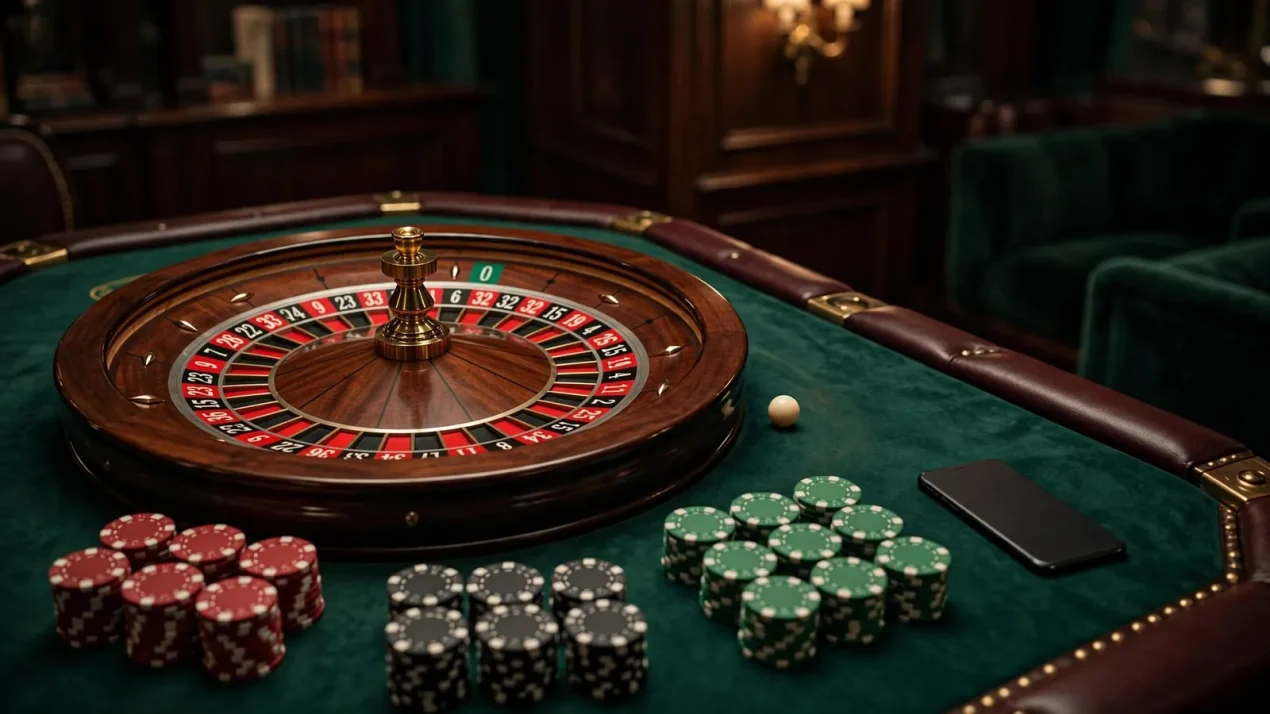
A European roulette wheel is identified by its single green zero and numbered pockets from 1 to 36. Together, these make 37 pockets. In an online game, the wheel may appear as a physical object on screen or as part of a simulated interface; the decisive detail is the version of roulette the game says it offers, not how polished the animation looks.
That distinction matters when browsing an online casino with European roulette. A green pocket in a thumbnail is not enough to establish which variant is available: American roulette also has a single zero, alongside a double zero. The game information should identify European roulette explicitly, and the displayed wheel should agree with that description. If the rules and the visual presentation conflict, the label alone is not a sound basis for treating the game as European.
The wheel and the betting layout are separate parts of the game. The wheel shows the numbered pockets around which the ball moves; the table presents the areas where wagers are placed. A casino with a European roulette game may show both, or may prioritise the betting interface. Either way, the wheel’s defining feature remains its pocket set, not the arrangement of betting boxes on the screen.
A European roulette wheel with a green zero should therefore be read as a single-zero wheel only when the remaining pockets and the game rules support that identification. The zero is not a decorative marker. It is one of the outcomes, and its presence is part of the game’s structure. A green section by itself does not explain how the game treats a wager when the ball lands there; that depends on the specific rules attached to the table.
For a European roulette casino wheel presented online, the clearest check is consistency across the game title, rules panel and wheel graphic. The title should specify the European version, the rules should describe that version, and the graphic should show the corresponding single-zero set. These details are more useful than a generic label such as “roulette”, which does not identify the wheel variant.
The difference between a rendered wheel and a live wheel is also worth keeping precise. A rendered image may represent the game without showing a physical wheel in a studio. A live presentation, by contrast, uses a real wheel and a dealer. Both can display European roulette, but the way the result is produced differs. The wheel’s variant and the game’s format are separate questions.
When an interface compresses the wheel or hides it behind the betting screen, the rules remain the more reliable reference. A clear description of the game can establish whether it is European roulette even when the wheel graphic is small. If neither the rules nor the display makes the version clear, the game should not be assumed to use a European wheel merely because the page groups it with roulette titles. A 37-pocket wheel is a precise format, not a loose visual category.
This material was created by the Lucky Vegas UK Guide team.
Related posts

UK Online Casino Ratings and Amatic Games

Wazdan Online Casinos in the UK: Availability Checks
