
Live Roulette UK with English-Speaking Dealers
 Available in GB
Contents
Live roulette pairs a real-time dealer stream with betting controls, while rules, stakes and offer terms shape how each table session works.
How Live Roulette Works on a UK Casino Site
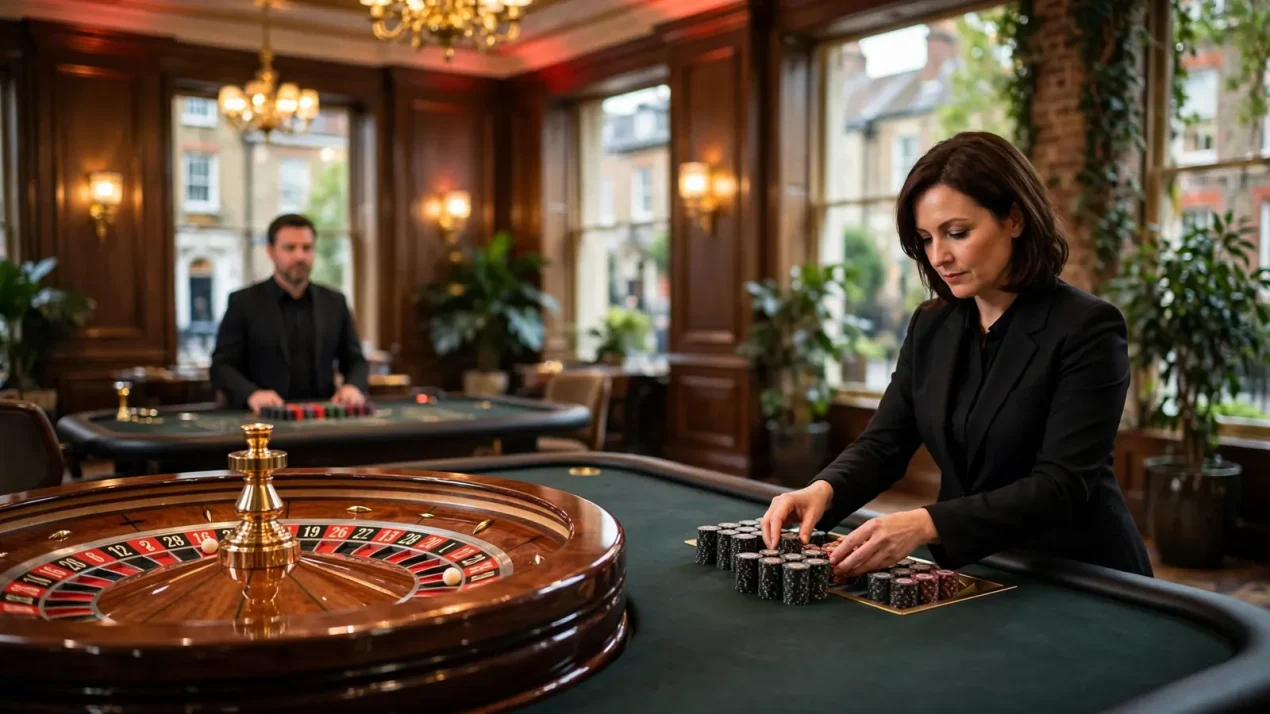
Live dealer roulette combines a video stream from a studio with a betting interface on the casino site. A human dealer operates the game in real time; the camera shows the action, while the player uses on-screen controls to place bets. The result is a remote version of a table session, not a recording of a completed game and not simply a digital wheel animation.
The screen is divided between the live video and the controls for the current round. The video shows the dealer and the physical wheel. The interface displays the available betting area and lets a player select a stake and submit a bet. These elements serve different purposes: the stream presents the live game, while the interface communicates the player’s choices to the table.
A session begins by opening a live roulette table from the casino’s game area. The table view provides the information needed to participate, including the dealer’s stream and the controls for betting. Where several tables are available, their descriptions may distinguish them by features such as the dealer or language. A table should not be assumed to have an English-speaking dealer just because the casino site itself is displayed in English; the table’s own description is the relevant information.
When choosing live roulette in the UK, check what is known about payouts alongside whether a table suits your preferences. This list provides a concise reference for considering payout speed.
1. WinBeast
Payout speed: 1-3 business days
WinBeast lists a payout speed of 1–3 business days.
2. Zombillion
Payout speed: 1-3 business days
Zombillion lists a payout speed of 1–3 business days.
3. Chanze
Payout speed: 1-3 business days
Chanze lists a payout speed of 1–3 business days.
4. BeOnBet
Payout speed: 1-3 business days
BeOnBet lists a payout speed of 1–3 business days.
5. Jetsetspins
Payout speed: 1-3 business days
Jetsetspins lists a payout speed of 1–3 business days.
6. Revery Play
Payout speed: 1-3 business days
Revery Play lists a payout speed of 1–3 business days.
7. Dieselwin
Payout speed: 1-3 business days
Dieselwin lists a payout speed of 1–3 business days.
8. SpinFormula
Payout speed: 1-3 business days
SpinFormula lists a payout speed of 1–3 business days.
9. NightWin
Payout speed: 1-3 business days
NightWin lists a payout speed of 1–3 business days.
10. NightLuck
Payout speed: 1-3 business days
NightLuck lists a payout speed of 1–3 business days.
Once the table is open, the player follows the round on screen and makes selections through the betting interface. The selected stake and chosen positions are displayed as part of the on-screen layout. The bet is submitted through the interface rather than communicated verbally to the dealer. The dealer continues to operate the physical game, while the software relays the player’s selections to the live table.
That division of roles is central to how online live dealer roulette works. The dealer does not need to see a player or receive instructions by voice. The player interacts with the casino software, and the software connects those choices to the game being shown in the studio. The video makes the dealer’s actions visible; the interface records the betting decisions. A live stream alone is not enough to participate, and an interface without the live game would not provide the same dealer-led format.
The round proceeds on the live table, with the interface indicating when betting is available and when selections can no longer be made for that round. The dealer’s actions and the wheel are shown in the stream, while the site updates the game display. Once the outcome is established, the interface reflects the result and the session moves on to the next round. The player does not control the wheel or the dealer’s actions; the role is to choose whether and where to place a bet through the available controls.
Monopoly Live Casino UK: Format, Play and Terms
This is also why live dealer roulette differs from a fully digital roulette game in presentation. In a digital version, the game is generated on screen without a human dealer operating a physical wheel in a studio. In a live table, the dealer and wheel are part of the real-time broadcast. The betting still takes place online, but the game being watched is conducted in the studio.
The phrase “English-speaking dealer” concerns the person presenting the table, not the language of every element of the casino site. A site may have English-language menus while a particular live table uses another language, or a dealer may speak during the broadcast without every interface label being spoken aloud. Table information is therefore more useful than the general site language when identifying a suitable session. Availability can vary by table, so it should be checked at the point of selection rather than treated as a feature of every live roulette game.
The same basic format applies whether the table is opened on a computer or another supported device: the live picture and the betting controls are presented on screen. The essential interaction remains the same. The stream shows the human dealer conducting the game, and the player submits choices through the interface. No spoken exchange is required to make a bet.
Attention: A casino’s presentation of a studio stream does not, by itself, establish that the operator is licensed under the UK Gambling Commission.
For UK players, live dealer casinos are legal when operated under a UK Gambling Commission licence. That condition concerns the operator offering the game; the live format itself describes how the session is delivered. A casino’s presentation of a studio stream does not, by itself, establish that the operator is licensed.
Live dealer roulette is therefore best understood as two connected parts: a real-time studio broadcast and an online system for placing bets. The dealer provides the visible action, and the interface handles the player’s participation. The content is for entertainment purposes only and is not gambling advice.
Roulette Casinos: The UK Licence and the Live Table
A roulette casino serving customers in Great Britain needs the appropriate operating licence from the UK Gambling Commission (UKGC). That requirement applies whether the business is based in Britain or elsewhere: an overseas location does not remove the licensing condition when the operator offers remote gambling to the British market. A live dealer table does not create an exception to the rule.
For a customer, the distinction is between a casino authorised to provide gambling in this market and a site operating outside the UKGC system. A foreign licence, by itself, is not the UK operating licence required for a casino serving British players. Legal online gambling in the UK is limited to licensed and regulated sites, so the relevant question is not simply where a brand is based, but whether the operator holds the required UKGC authorisation.
Live Dream Catcher Casino UK: How It Works
That condition applies to live dealer roulette as well as other online casino games. A roulette casino UK customers can legally use must be covered by a current operating licence; presenting a real dealer or a physical wheel does not change the operator’s regulatory status. The licence concerns the business providing gambling, while the physical or computerised nature of a roulette game concerns how its result is produced. These are separate matters, and neither substitutes for the other.
What makes a roulette table live
In live roulette, a dealer spins a physical wheel. The game’s result comes from the ball’s movement on that wheel, rather than from a computerised roulette outcome generated by a Random Number Generator (RNG). The online presentation may make the table appear within the casino’s digital interface, but the defining feature is the physical wheel and dealer operating it.
Computerised roulette uses an RNG to determine the result. There is no physical wheel producing that outcome. Both formats can appear within an online casino, but they are not interchangeable descriptions of the same game: one is based on a dealer-spun wheel, the other on a computer-generated result.
This difference matters when identifying what a table actually offers. A roulette game labelled as live dealer roulette should involve a human dealer and a physical wheel. A computerised game may still resemble a conventional roulette table on screen, but its result is generated by software. The screen design alone does not establish which format is being used; the game’s stated format does.
Live Dealer Roulette
Involves a human dealer and a physical wheel; the result comes from the ball’s movement.
Computerised Roulette
Uses a Random Number Generator (RNG) to determine the result without a physical wheel.
Licence and format are separate checks
A UKGC licence establishes that an operator is authorised to offer regulated gambling to customers in the British market. It does not mean that every roulette game on the site is live, or that a live table uses a physical wheel. Those details belong to the game format. Conversely, a physical wheel and human dealer do not establish that the casino itself holds the required licence.
The practical distinction is therefore two-part. The operator’s regulatory status concerns whether it may legally offer the casino service in this market. The table’s format concerns whether the roulette result comes from a physical wheel or an RNG. Treating the dealer as proof of licensing confuses the game with the business providing it; treating a licensed casino as proof that every game is live makes the opposite mistake.
The UK Gambling Commission is the regulator associated with the required licence for remote operators serving Great Britain. The Gambling Act 2005 governs gambling in England, Wales and Scotland, while Northern Ireland is outside that Act’s scope. Across the UK market, the essential point for an online casino is that legal service to UK players depends on the applicable UK authorisation, not merely on the presence of a live dealer.
A roulette live casino is therefore not defined by its licence, and a licence is not defined by the roulette format. Both descriptions answer different questions: whether the operator is authorised for the market, and whether the game uses a physical wheel rather than a computerised random outcome.
Live Blackjack Online Casinos in the UK
Roulette Casino Sites: What the Live Format Requires
A live roulette table places more demands on a connection than a digital version. The game is streamed as it happens, so a stable internet connection is necessary for the video and the betting interface to remain usable together. If the stream stalls or becomes unreliable, the table experience can be interrupted; the result is not equivalent to watching a finished recording because the game is taking place in real time.
That distinction matters when comparing roulette casino sites. A site can present a live table, but the practical experience still depends on whether its stream can be followed consistently. A brief interruption may make it harder to keep track of a round or to see when the table is ready for the next one. The interface and the live feed are parts of the same session, not separate conveniences.
Live play also takes longer than digital roulette. A human dealer operates the physical game, and each round follows the pace of that table. Digital versions can move through rounds more quickly; a live table cannot be treated as a faster version of the same process. The slower rhythm is a feature of the format, but it changes how long a session may take and how often decisions arise.
The difference affects the shape of play. Someone comparing live roulette casino sites with digital options is not comparing only screen design. The live format brings a streamed table and a slower round cycle; digital roulette offers a quicker sequence. Neither pace changes the underlying need to set a budget before playing. A longer session can extend the time spent at the table, but it does not make the game more predictable.
Live roulette is a slower form of play than digital versions because it follows the pace of a human dealer operating a physical game.
Live tables also have higher minimum bets than digital versions. That is a practical difference, not a claim about every individual table or a fixed market-wide figure. The minimum shown at a particular table determines whether its entry point fits the intended spend. A table that cannot be played within the planned budget is not made suitable by a polished stream or a familiar interface.
For UK players comparing live roulette sites, the relevant distinction is therefore between format and personal fit. The live format requires a dependable connection and allows less control over the pace of each round. Its minimum bets are higher than those of digital games. These conditions can be considered before a session begins; they cannot be corrected by choosing a different betting pattern once the game is under way.
The label “best live roulette casino site” has little meaning without a clear measure. For one person, a stable stream may be the deciding condition; for another, the table minimum may rule a site out immediately. A list of top sites would conceal those differences if it treated the live format as identical everywhere. The useful comparison is narrower: whether the connection is dependable enough for a real-time stream and whether the table’s entry point fits the budget.
A live table is not designed to remove waiting. It is a slower form of play, and the session should be planned accordingly. When a stable connection is unavailable, the live format is a poor match for that moment. When the minimum bet exceeds the set budget, the arithmetic is equally plain. Casino play is for entertainment, not financial advice.
Deal or No Deal Casino UK: Slot Game Guide
Assessing Roulette Casino Terms Without a Rankings List
A “best” roulette casino is not a single, measurable category. One site may offer a live table that suits a particular session but attach restrictive bonus conditions; another may have clearer terms but a different choice of tables. A useful comparison separates the live format, the table conditions and the promotion. Combining them into one score hides the trade-offs.
Separate the product from the promotion
The live format is a service, not a bonus. Live games run more slowly than digital versions and require a stable internet connection. Their minimum bets are also higher. These conditions affect whether a table fits the intended session, but they do not establish that a casino is better overall.
Promotions need a separate calculation. A headline bonus has little practical value for roulette if live games contribute only a small share towards its wagering requirement. Some terms assign live games a weighting such as 10%, meaning only that proportion of qualifying roulette stakes counts towards the requirement. The stated bonus amount therefore cannot be treated as the amount available to withdraw.
The comparison should record whether live roulette is eligible, what weighting applies, and whether other conditions restrict the offer. A promotional figure without its rules is not a useful basis for choosing a site; it is only the most visible part of the offer.
Do
- Separate the live format from the promotion
- Check the specific weighting for live games
- Assess the table on its own terms
Don’t
- Treat a headline bonus as a guaranteed withdrawal
- Use a general site ranking as a replacement for terms
- Assume all roulette games contribute equally to wagering
Compare like with like
A fair comparison uses the same questions for each casino. Is the table live dealer roulette or a digital game? What minimum stake applies at the relevant table? Does the promotion include live games, and how are they weighted? Are there additional restrictions attached to the offer? Keeping these points separate makes the differences legible without turning an arbitrary preference into a ranking.
Table conditions matter independently of bonus terms. A promotion cannot compensate for a minimum stake that does not fit the planned budget, and a suitable table does not make an unsuitable promotion worthwhile. The calculation is straightforward: assess the table on its own, then assess the offer on the rules that govern it. A budget should be set before play and kept separate from any promotional balance.
The same method applies when looking for the best live roulette casino in the UK. “Best” depends on which condition carries the most weight: a particular live-table setting, a manageable minimum stake, or bonus terms that do not exclude the intended game. Without that priority, a ranking gives the appearance of precision while mixing unlike features.
Read the terms as conditions, not claims
The offer page and its terms should be read together. The headline describes what is being promoted; the terms define which games qualify and how play is counted. If roulette is excluded, or its contribution is low, the bonus calculation should be made without assuming that ordinary roulette stakes will satisfy the requirement at face value.
Crazy Time Live Casino Game in the UK: How It Works
A comparison can be kept in a simple record: live or digital format; table minimum; roulette eligibility; game weighting; other bonus restrictions. Missing or unclear conditions should remain unresolved rather than being interpreted in the casino’s favour. That is not a verdict on the operator; it is a reason not to count the offer as usable until its terms are clear.
No operator ranking can replace this check. The strongest option is the one whose actual table conditions and promotion rules fit the stated budget and intended use, not the one with the largest headline offer. The article is for entertainment purposes only and is not gambling advice.
Roulette Game Rules: European and American Wheels
Roulette is organised around numbered pockets on a wheel and matching numbers on the table layout. A dealer sets the ball in motion around the wheel; the result is the pocket where it comes to rest. A player wins when the number selected matches that result. The wheel and table must correspond, because the available outcomes depend on the version being played.
The difference between European and American Roulette is visible in the green pockets. European Roulette has one: 0. American Roulette has two: 0 and 00. The extra pocket is not a second spelling of zero or a decorative feature. It is a distinct possible result, shown separately on the American table layout.
That changes the number of possible outcomes. The stated chance of winning in European Roulette is 1 in 37; for American Roulette, it is 1 in 38. The additional 00 creates one more outcome without changing the basic condition for a number selection to win: the ball must land on the number chosen. A selection that matches a pocket on one version should not be assumed to have the same chance on the other.
European Roulette
Features one green pocket (0), resulting in a 1 in 37 chance of winning a straight-up bet.
American Roulette
Features two green pockets (0 and 00), resulting in a 1 in 38 chance of winning a straight-up bet.
Reading the layout
The table is the working map for placing selections on the wheel’s numbers. The green zero area is the key point to identify before play, particularly when the interface presents a compact layout or uses a label for the game version. In European Roulette, the single green pocket is 0. In American Roulette, both 0 and 00 are present. If the layout displays a double zero, it is the American version, not a European table with an extra betting option.
This distinction matters even when the selected number is not green. The result still comes from the full set of pockets on the wheel, including the green one or two. A chosen number can therefore be correct only when it is the number where the ball stops; selecting a nearby number or a number in the same area does not change that match condition.
The wheel and betting layout should be read as a pair. A visual grid can make the numbered selections easy to locate, but it does not remove any possible wheel result. The zero pockets remain part of the outcome set, even if a player is focusing on other numbers. On an American table, both green results matter to the chance comparison; on a European table, there is only one.
Why the extra pocket matters
The difference between 1 in 37 and 1 in 38 follows directly from the layout: American Roulette includes 00 in addition to 0. With one more possible result, the same selected number has a lower chance of being the landing number than it has on the European wheel. That is a structural difference between the games, not a change in how a number selection is settled.
For a UK casino game, the useful check is therefore the version name and the visible zero pockets, not merely the word “roulette”. European and American Roulette share the same basic idea of matching a selection to the ball’s final number, but their layouts do not offer the same set of outcomes. The zero area is small on screen and decisive in the comparison.
Hi-Lo Casino UK: Rules, Calls and Payouts
Playing Roulette for Money: Pace, Stakes and Table Rules
A live roulette session is not priced or paced like a digital game. Each round takes longer, and the minimum stake is higher than on digital versions. That changes the practical cost of staying at a table: the minimum applies whenever a bet is placed, while the slower rhythm means fewer rounds take place over the same period. Neither condition improves the chance of a return; they determine how quickly money is committed and how long a session may run.
Minimums vary by table. A specialist review reports that some live roulette and baccarat tables start at around 20p, but that is a reported figure, not a fixed market standard. The minimum shown at the table is the relevant amount. It should be checked before play begins, alongside any maximum stake and the rules governing accepted bets. A table’s advertised minimum does not establish the cost of every possible bet or session.
Before staking money, the table rules and paytable need to be read together. The rules establish which bets can be placed and when the table accepts them; the paytable states what a winning bet returns. A payout should not be assumed from a bet’s name alone. If the displayed terms differ between tables, each table needs to be assessed on its own terms.
The live format also leaves less room for hurried decisions. Rounds move more slowly than digital roulette, but bets still need to be made within the table’s betting window. The available time can affect how a session feels, not the underlying terms. A slower game is not a lower-cost game when its minimum stake is higher.
A useful session calculation begins with the amount set aside before play, then compares it with the table minimum and the planned number of rounds. If the minimum makes the intended session unaffordable, the table does not fit the budget. Increasing the budget after losses changes the limit rather than correcting the calculation. Stakes should remain within the amount set in advance; past outcomes do not justify raising them.
For anyone deciding how to play roulette for money at a UK casino, the practical checklist is short: confirm the minimum, read the table rules and paytable, and set a firm budget before placing a bet. These checks do not remove the financial risk. They make the cost and conditions visible before money is committed. This information is for entertainment purposes only and is not gambling advice.
Free Roulette Play: What It Does Not Pay
Free roulette play separates the game’s outcome from a cash stake. The ball still lands on a number, and a winning result depends on having selected that number. But when no real money is staked, a correct selection does not produce a real-money payout. The result is an example of how a round resolves, not income.
That distinction matters when assessing a free roulette casino in the UK. A screen may resemble a paid table, and the result may be presented in the same familiar format, but appearance does not change the value of the outcome. Free play can show the basic relationship between a selected number and where the ball lands; it cannot turn a successful selection into withdrawable funds.
It also provides no evidence about what will happen in a later round. A number appearing during free play does not make it more likely to appear again, or less likely to appear when money is involved. Each displayed result is an outcome in its own round. Treating a run of free results as a forecast gives it a purpose it does not have.
The practical value is therefore limited but clear: free roulette can be used to become familiar with the sequence of choosing and observing a result without risking a cash stake. It is not a source of winnings, a test that establishes future performance, or a substitute for reading the conditions of a paid table. A successful free result remains a free result.
Free roulette play is used to become familiar with the game sequence; it does not produce real-money payouts or forecast future results.
The same distinction applies to French Roulette rules or a named roulette format. The label does not alter the basic point: without a real-money stake, the game does not pay real money. Any special table rules belong to that game’s own terms; free play alone does not establish how a paid version settles every bet.
Free casino roulette should also not be confused with a promise of a cost-free route to a cash balance. The relevant question is not whether the game can display a win, but whether real money was staked and whether the rules provide a payable return. In free play, there is no real payout to collect.
This is an explanation of game outcomes for entertainment purposes only, not gambling advice. The financial distinction is straightforward: a selected number can match the ball’s landing point, but a free round pays nothing.
Roulette Bonuses: Wagering Weight and Offer Conditions
A roulette casino bonus can look relevant because roulette appears in the casino’s live-game lobby. That does not mean the promotion can be used at the table, or that roulette stakes count fully towards its wagering requirement. The headline amount describes the offer; the terms determine whether it has practical value for live play.
A specialist review reports that most UK welcome offers are free spins for slot games, which cannot be used at live tables. That makes a welcome bonus aimed at slots separate from a live roulette promotion, even when both appear on the same casino site. A roulette casino welcome bonus should therefore be assessed by its eligible games and contribution rules, not by its title.
The same distinction applies to a no-deposit offer. The label alone does not establish that live roulette is eligible, that winnings can be withdrawn without conditions, or that the offer is available. Those points depend on the operator’s current terms. A promotion that cannot be used at the live table has no direct value for a player seeking a roulette bonus.
A specialist review also reports that live games may contribute only a small share towards wagering requirements; one cited example is 10% weighting. If that weighting applies, only a fraction of eligible live-game stakes counts towards the requirement. The rest does not disappear from the player’s balance calculation, but it does not advance the bonus requirement at the same rate as a fully weighted game. The exact contribution must be checked in the offer terms.
Before opting in, the relevant checks are whether live roulette is included, what weighting applies, which bonus funds or winnings are restricted, and whether a maximum bet limit applies while wagering. A headline offer can be generous in appearance and narrow in eligible use; the calculation is based on the rules, not the banner.
This is a terms comparison, not a reason to increase stakes or extend a session. Set a budget before playing and keep to it. Gambling content is for entertainment purposes only and is not gambling advice.
Attention: Set a budget before playing and keep to it. Do not raise your budget to recover losses or extend a winning run.
Roulette Odds and the Limits of Any Winning System
The search for the best way to win roulette often assumes that a particular system can overcome the game’s underlying margin. It cannot. A staking pattern may change how bets are arranged or how a session’s balance moves, but it does not remove the house edge or make a selected number more likely to win.
The stated house edge is 2.9% for a straight-up bet and 2.7% for other roulette bets. The difference is small, but it is still a difference in the casino’s mathematical advantage. A straight-up bet selects one number; other bets cover different outcomes. The lower figure does not turn those bets into a reliable route to profit. It describes the edge, not what any individual round will return.
That distinction matters when considering how to win at roulette in a casino or online. A bet can win, but no sequence of previous results guarantees that the next ball will land on a chosen number. Increasing a stake after a loss changes the amount exposed; it does not repair the odds. A system that appears successful over a short run can still end with a loss, while a winning round does not prove that the method has an enduring advantage.
French Roulette changes the result for one specific case. When the ball lands on zero, an even-money bet loses only half its stake rather than the whole amount. That rule reduces the impact of zero on those bets, but it does not guarantee a win or apply to every type of wager. The table’s rules determine whether that condition applies.
The same limits hold for electronic roulette. Changing the display or delivery format does not make a betting system certain to succeed. The useful comparison is between the stated edge and the applicable table rule, not between claims of a guaranteed method.
A sound assessment therefore treats every stake as money at risk, rather than as a step towards a certain outcome. Set a budget before play and keep to it; do not raise it to recover losses or extend a winning run. This is entertainment, not gambling advice.
Lightning Roulette: What Can Be Confirmed
The name Lightning Roulette may appear in a UK casino’s live section, but the label alone does not describe how a particular game produces its result. The relevant distinction is between roulette played at a physical wheel and a computerised version.
In live roulette, a dealer spins a physical wheel. The game is streamed, and bets are placed through the on-screen interface. Computerised roulette instead uses a Random Number Generator (RNG) to produce the result. These are different formats: one shows a dealer operating a wheel, while the other generates outcomes through software.
That distinction matters when comparing listings for Lightning Roulette casinos or searching for a Lightning Roulette live casino in the UK. A live-casino label should be understood in the context of the game being offered, rather than as evidence about special rules or a particular result mechanic. Likewise, a listing described as a roulette slot should not be treated as proof that it uses a physical wheel.
The practical check is the format shown by the casino: a dealer and physical wheel indicate live roulette; an RNG indicates computerised roulette. The title itself does not establish which format is in use. It also does not provide a basis for predicting outcomes or for treating previous results as guidance for future spins.
For a casino Lightning Roulette listing, the dependable distinction remains the mechanism behind the spin. A physical wheel operated by a dealer is live roulette; an RNG-produced result is computerised roulette. The terminology may be similar, but the format is not interchangeable.
What are the different types of roulette you can play with a live dealer?
Live dealer roulette includes European, American and French versions. They differ in their wheel layouts and, in French Roulette, the rule for even-money bets when the ball lands on zero.
What is the difference between European and American Roulette?
European Roulette has one green pocket, 0, while American Roulette has two, 0 and 00. The odds of winning are 1 in 37 on a European wheel and 1 in 38 on an American wheel.
How does the house edge change between games?
In roulette, the stated house edge is 2.9% for straight-up bets and 2.7% for other bets. French Roulette’s rule that an even-money bet loses only half when the ball lands on zero also reduces the loss on that outcome.
How do you play live roulette?
Open a live roulette table, choose a stake and select your bets using the on-screen interface while following the dealer and physical wheel on the video stream. Submit your choices before betting closes; the dealer runs the game, and the interface displays the result.
This material was created by the Lucky Vegas UK Guide team.
Related posts

UK Online Casino Ratings and Amatic Games

Wazdan Online Casinos in the UK: Availability Checks
